
Clean fill is the heavy, unglamorous end of almost every outdoor project. Dig a garden bed, break up a patio, take out a walkway or excavate for an addition, and you end up with a pile of soil, concrete, brick and stone that has to go somewhere. Where it can go depends on one word: clean.
This guide explains what clean fill means in practice, what turns a load into something else, how Ontario's excess soil rules fit in, and why bin companies handle this material differently from everything else. It is written for homeowners and small contractors. It is not legal advice, and the provincial rules are still being phased in, so check the official sources linked below for anything that affects a larger project.
What clean fill means
The term gets used two ways. Sometimes it means material you are getting rid of: excavated soil, broken concrete, brick, block and stone with nothing else mixed in. Sometimes it means material you are bringing in to raise a grade or backfill a hole. Either way, the idea is the same: inert, natural or mineral material, free of garbage and free of contamination.
In everyday hauling terms, these usually count as clean fill:
- Excavated soil and subsoil with no debris in it.
- Broken concrete from slabs, walkways, footings and steps.
- Brick, concrete block and natural stone.
- Gravel and crushed stone.
Asphalt from a driveway tear-out is often handled alongside it, since it is heavy and recyclable, but some receiving sites treat it as its own stream. Ask before you mix it in.
What makes a load not clean
A load stops being clean fill when it contains things that cannot be crushed, screened and reused, or things that might contaminate the place it ends up. Common problems:
- Wood, including roots, stumps and form boards left in the concrete.
- Garbage of any kind: plastic, bags, cans, packaging.
- Drywall, insulation, shingles or other renovation debris.
- Large tangles of rebar or wire mesh. Some recyclers take concrete with steel in it and some charge more, so ask.
- Soil that smells of fuel or oil, is stained, or came from near an old oil tank, a garage floor drain or a former industrial use.
- Sod and heavy organic material. Topsoil with grass and roots behaves differently from subsoil, and many receiving sites want it kept separate.
The contamination question is the serious one. Soil from a residential garden is usually fine. Soil from around a leaking oil tank, an old gas station or a commercial property with a long history is a different matter, and may need testing before anyone will take it. If you have any reason to suspect contamination, stop and get advice before you dig further. Contaminated soil does not go in a rental bin.
Ontario's excess soil rules, in plain terms
In December 2019, Ontario made a regulation under the Environmental Protection Act called On-Site and Excess Soil Management, known as O. Reg. 406/19. The province's overview page, Handling excess soil, describes excess soil as soil that has been dug up, usually during construction, and has to be moved off-site because it cannot or will not be reused there.
According to that page, the regulation is being phased in:
- From January 1, 2021: rules for reusing excess soil, including risk-based quality standards and clarity on when excess soil is not a waste.
- From January 1, 2023: testing, tracking and registration requirements, with some exemptions.
- From January 1, 2027: restrictions on landfilling cleaner soil that is suitable for reuse.
The heavier requirements, such as reuse planning, soil sampling and filing notices in the Excess Soil Registry run by the Resource Productivity and Recovery Authority, are aimed at larger projects and riskier sites. The province's page describes reuse planning for sites generating more than 2,000 cubic metres and for higher-risk properties such as gas stations and industrial sites. A homeowner digging out a garden bed is generating a tiny fraction of that.
That does not mean small loads can go anywhere. The direction of the rules is clear: clean soil should be reused, not dumped, and soil should end up at a site that is allowed to receive it. In practice, for a homeowner, that means:
- Do not dump soil or concrete on vacant land, in a ravine, or on a farm field without the owner's permission and the right approvals.
- Expect municipal site alteration or fill by-laws to apply when you move soil around your own property in ways that change the grading. Oshawa's demolition and disconnection package, for example, notes that adding or removing soil that changes land levels may need site alteration approval.
- Use a hauler that takes the material to an approved facility.
The rules are detailed and are still changing, especially with the 2027 landfill restriction coming. If your project is large, involves a commercial or industrial property, or you are bringing fill in rather than taking it out, read the provincial guidance or ask a qualified person before you start.
Why haulers price clean fill separately
If you have ever wondered why a bin company asks what you are loading before it quotes, this is the reason.
Weight. Soil runs about 1.0 to 1.4 tonnes per loose cubic yard by our planning figures, and broken concrete, brick or asphalt about 1.1 to 1.4. Solid concrete in place is closer to 1.8 tonnes per cubic yard. A bin that holds a tonne or so of renovation debris when full would hold many times that if it were filled to the top with concrete, far beyond what a roll-off truck can safely lift or what is legal on the road.
Where it goes. Clean concrete and brick can be crushed into aggregate. Clean soil can be screened and reused. Those facilities are different from the transfer stations that take mixed waste, and they care a great deal about what is in the load.
Contamination risk. One wheelbarrow of garbage in a concrete load can turn a recyclable load into mixed waste, which costs more to dispose of and may be refused at the recycler.
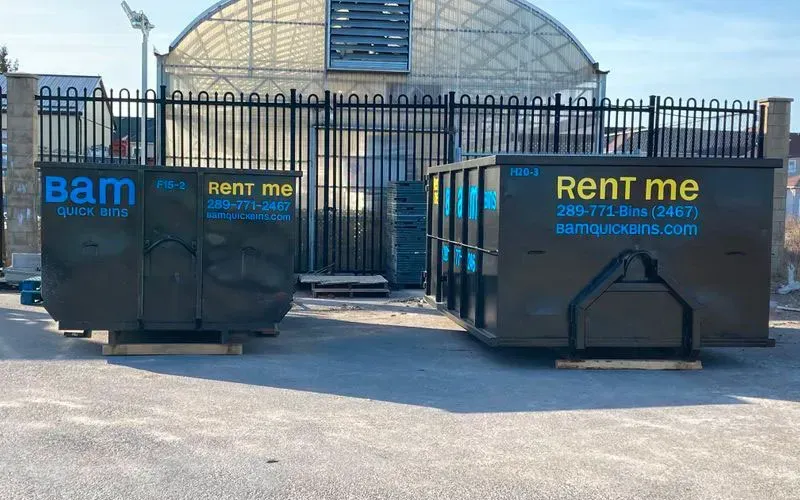
So the industry keeps this material in its own stream. With our dirt and concrete bins, you tell us what you are hauling, we pick the bin, and it is filled only partway so the truck can still lift it. Soil and concrete can usually share a bin; tell us the mix when you book. Not every disposal site takes it either: Barrie's landfill, for one, says it does not accept topsoil or clean fill.
How much do you have?
Measure before you book. Volume in place is length times width times depth, in feet, divided by 27 to get cubic yards.
- A walkway 3 feet wide, 30 feet long and 4 inches thick: 3 x 30 x 0.33 = about 30 cubic feet, or 1.1 cubic yards. At around 1.8 tonnes per cubic yard for solid concrete, that is roughly 2 tonnes.
- A garden bed 10 by 12 feet dug 1 foot deep: 120 cubic feet, about 4.4 cubic yards. At 1.0 to 1.4 tonnes per cubic yard, that is roughly 4.5 to 6 tonnes of soil.
- A small brick planter or a set of concrete steps is usually well under a cubic yard but can still weigh more than a tonne.
Material swells when it is broken or dug up, so the loose pile takes more room than the hole did. Weight does not change, though, and weight is what limits a heavy-load bin. Our cubic yard calculator does the arithmetic, and the material weight chart lists the planning figures.
Small bins for heavy material
For clean fill, smaller is better. A 10-yard bin is the size we use for soil, concrete, brick and stone, because weight fills it long before the space does. Putting heavy material in a 20-yard bin just leaves you with a bin that cannot be legally lifted. Our 10-yard bin guide covers the dimensions. In the Cambridge area, the division runs a 9-yard bin for the same job.
A few loading rules keep everything moving:
- Book the bin before you dig, and load straight from the hole. Shovelling a pile twice is wasted work.
- Spread the weight across the floor of the bin rather than heaping it at one end.
- Fill only to the level we tell you. With heavy material, that line is well below the top.
- Keep it clean. Pull roots, wood and garbage out as you go.
- Wet soil weighs noticeably more than dry. If it has been raining for a week, the same pile is heavier.
Bringing clean fill in
Sometimes the problem runs the other way: you need fill to raise a low yard, backfill around a foundation or build up a base. The same word, clean, matters just as much.
Know what you are ordering. Fill, topsoil and screened topsoil are different products. Fill is for bulk and structure, under a patio, behind a wall, in a hole. Topsoil is what grass and plants grow in, and it goes on top in the last few inches. Ordering topsoil to fill a deep hole wastes money; using fill where you want a lawn gives you a lawn that never thrives.
Ask where it came from. A reputable supplier can tell you. Soil from a residential excavation is one thing; soil from an old commercial or industrial property is another, and you do not want it in a vegetable garden.
Be wary of free fill. Offers of free dirt, often from a nearby construction site, can be fine. They can also be a way for someone to get rid of material they would otherwise pay to dispose of. Loads can contain chunks of asphalt, wood, garbage, invasive plant roots, or soil nobody has tested. Once it is spread on your property, it is your problem. Look at a load before it is dumped, and refuse anything that is not what was promised.
Check before you raise the grade. Bringing in a lot of fill can change how water drains across your lot and onto your neighbour's, and that is exactly what municipal site alteration by-laws are written to control. A call to the municipality before the trucks arrive costs nothing.
Order the right amount. Measure the area and depth, convert to cubic yards, and add a little for compaction. Fill settles as it is packed, so a hole usually takes more than its measured volume.
Reuse before you haul
The cheapest load of clean fill is the one that never leaves the property. Soil from a garden bed can often level low spots, backfill a trench, or build up a raised bed elsewhere in the yard. The Region of Waterloo, for one, suggests spreading excess dirt on lawns or flower beds rather than throwing it out. Broken concrete can be reused as a base under a shed or as rubble fill in a spot that will never be built on.
Two cautions. Do not change the grading so water runs toward your foundation or your neighbour's, and check whether your municipality's site alteration rules apply before you move a lot of material. Our guide to concrete disposal covers the patio and walkway side of this, and our sod removal guide covers what to do with an old lawn.
Where we help
We supply heavy-load bins for soil, concrete, brick and stone across our service area, including Vaughan, Mississauga, St. Catharines, Niagara Falls and Oshawa. Tell us what the material is, roughly how much there is, and whether anything else is mixed in, and we will size the bin and tell you how full it can go.