A backyard pool is a great thing to have, right up until it isn't. The liner needs replacing again, the heater has given up, the kids have grown and moved out, and the opening and closing bills keep arriving. At some point the question shifts from how to keep the pool running to how to get the yard back.
Pool removal is a bigger job than most people expect, especially for an inground pool, but it is very doable with good planning. This guide covers both above-ground and inground pools: where the water can go, how to take an above-ground pool down yourself, the choice between filling in an inground pool and removing it completely, permits and locates, where each material ends up, and how much fill and how many bins you will need.
Why people take pools out
The reasons are usually practical. Maintenance costs add up every year, and a big repair, like a new liner, a cracked shell, or a failed heater, forces the decision. Safety is another common reason, especially when young grandchildren start visiting. Some people simply want the space for a garden, a patio, or a lawn the dog can run on.
Selling a house can go either way. Some buyers want a pool, while others see only the upkeep, so talk to a local real estate agent before you remove a pool for resale reasons alone.
Draining the pool: where the water can go
Pool water cannot simply be pumped into the street. Chlorinated and salt water harm fish and plants, so it should never go into storm drains, roadside ditches, creeks, or ravines.
Most Ontario municipalities set rules for pool water in their sewer use bylaws. Some want it drained into the sanitary sewer, often through the cleanout in your basement. Others allow it onto your own lawn once the chlorine has dissipated, as long as the water does not flow onto neighbouring properties. To let chlorine levels drop, stop adding chemicals for several days and test the water with a pool test kit before draining. Salt water pools need more care, since salt damages grass and gardens. Check your municipality's rules before you start pumping.
A rented submersible pump drains a pool much faster than a garden hose siphon. Drain slowly enough that the water soaks in or flows where it should, rather than flooding the yard.
For inground pools, wait to drain until the removal is ready to start. An empty inground pool can shift or lift with groundwater pressure, and it becomes a deep, slippery hole with nothing to stop someone falling in.
Keep the fence up until the hole is filled
Municipal pool enclosure bylaws exist to keep children out of deep water, and a half-demolished pool is just as dangerous as a full one. Leave the fence and gates in place, and keep them locked, until the hole is filled and levelled.
Once the pool is gone, the enclosure rules may no longer apply, but confirm with your municipality before taking the fence down. Let your home insurance company know about the change too. Insurers ask about pools for a reason, and your coverage or premium may change.
Taking down an above-ground pool
An above-ground pool is a reasonable weekend job for two people. Work in this order:
- Drain the pool completely.
- Unplug and disconnect the pump and filter. If anything is hardwired, have a licensed electrician disconnect it.
- Remove the ladder, steps, and any deck connections.
- Cut the liner into strips with a utility knife, roll the strips up, and set them aside. A wet liner is heavy and slippery, so cut it into pieces you can carry.
- Remove the top rails and caps. Rusted bolts can be cut with an angle grinder or a reciprocating saw.
- Remove the uprights.
- Take down the wall. Steel pool walls are long sheets that want to spring back into a coil, so wear heavy gloves, control the end as you unfasten it, and roll it up as you go.
- Lift out the bottom track and any foam cove.
The steel wall, rails, and uprights can go to a scrap yard, though light steel does not pay much; our scrap metal recycling guide explains what to expect. The liner, foam, and plastic parts go in a bin. A 10-yard bin usually has room to spare for an above-ground pool.
The sand base weighs more than the pool
The part people forget is the sand underneath. Even a couple of inches of sand under a 24-foot round pool works out to nearly 3 cubic yards, and sand weighs several tonnes per load that size. That is more than the rest of the pool put together.
You have three options. Spread it around the yard and rake it into the lawn or garden beds. Reuse it as a base for a patio or shed. Or haul it away in a clean-fill bin through our dirt and concrete service, never in a regular bin, where it would blow past the weight allowance.
Once the sand is gone, you will find dead grass or bare soil. Level it, add topsoil, and seed or sod.
Inground pools: what you are dealing with
Inground pools in Ontario come in three main types, and the type changes how much work removal is.
Vinyl liner pools are very common here. They have walls made of steel or polymer panels, a vinyl liner, and a floor of sand, grout, or concrete. Removal is mostly unbolting, cutting, and hauling.
Concrete pools, poured or sprayed, are the heaviest to remove. The shell has to be broken up with an excavator and a hammer attachment, and it produces a lot of heavy debris.
Fibreglass pools are a single moulded shell. They can sometimes be lifted out whole with a machine, or cut into sections.
Around all of them, expect a concrete deck or interlock patio, coping stones, buried plumbing lines, an equipment pad, and possibly a gas heater, underwater lights, and a diving board.
Partial removal or full removal?
This is the big decision for an inground pool, and it affects the cost, the timeline, and what you can do with the space later.
Partial removal, often called a fill-in, leaves most of the pool in the ground. The pool is drained, holes are broken through the floor so water can drain away rather than collecting like a bathtub, the top part of the walls and the deck are removed, and the hole is backfilled with clean fill, compacted, and topped with topsoil. It is faster and cheaper, and it is common when the area will only ever be lawn or garden.
The downsides are real, though. Material stays buried, building on that spot later can be difficult, poorly compacted fill can settle, and buyers and their home inspectors will ask about it when you sell. Depending on the circumstances, you may need to disclose it.
Full removal takes everything out: walls, floor, liner, steel, plumbing, and concrete. The hole is then backfilled with clean fill compacted in layers. It costs more and produces much more debris and trucking, but it leaves a clean site with nothing hidden underground.
If there is any chance you will build on that spot, like an addition, a garage, or a pool house, or if you plan to sell soon, full removal is usually the safer choice. Some homeowners also hire an engineer to oversee and document the compaction, which helps when a future builder or buyer asks. Whichever route you choose, keep the photos, invoices, and any compaction reports.
Permits, locates, and disconnections
Some municipalities require a permit to remove or fill in an inground pool, and most have lot grading rules that stop you from changing how water drains onto your neighbours' properties. Call your building department before the work is booked.
Before anyone digs, request free utility locates from the Ontario Dig Authority, formerly Ontario One Call. Pools often have gas lines running to a heater and electrical lines running to the pump, lights, and equipment. A licensed electrician should disconnect the electrical, and a licensed gas technician should disconnect and cap any gas line.
Where every material goes
A pool removal produces several distinct streams, and sorting them keeps costs down:
- Concrete from the deck, walls, and floor goes in clean-fill bins, where it is recycled as aggregate. Our guide to concrete disposal explains how those bins work.
- Interlock pavers and coping stones can be reused elsewhere in the yard, or go with the concrete.
- Steel wall panels, aluminum coping, ladders, and rails go to scrap.
- The vinyl liner, foam, plastic fittings, and PVC pipe go in a regular bin.
- A fibreglass shell, cut into sections, goes in a regular bin.
- A working pump, filter, or heater can be sold. Broken ones can be scrapped, since their motors contain copper.
- Leftover pool chemicals go to a household hazardous waste depot, never in a bin. Our household hazardous waste guide explains where.
How much fill you will need
To estimate the fill for an inground pool, multiply the length by the width by the average depth in feet, then divide by 27 to get cubic yards. A 16 by 32 foot pool that averages 5 feet deep holds about 95 cubic yards.
Order more than the raw volume. Fill compacts as it is rolled or tamped in layers, so it takes more loose material than the hole measures. Our cubic yard calculator does the arithmetic, and our guide to calculating cubic yards walks through irregular shapes like a pool with a deep end.
Most of the depth is usually filled with clean fill, with topsoil for the top layer so grass or plants can grow. It takes many truckloads to fill an average inground pool, so plan the route the trucks will take into the yard and protect any lawn or driveway they cross.
Sizing bins for a pool removal
The right bins depend on the pool and the method:
- An above-ground pool usually fits in a 10-yard bin, with the sand handled separately.
- A vinyl liner fill-in needs clean-fill bins for the deck and coping, plus a 10 or 15-yard bin for the liner, plastics, and odds and ends.
- A full removal of a concrete pool needs a series of clean-fill loads, which are filled only partway by design because concrete is so heavy. We will plan the swaps with you.
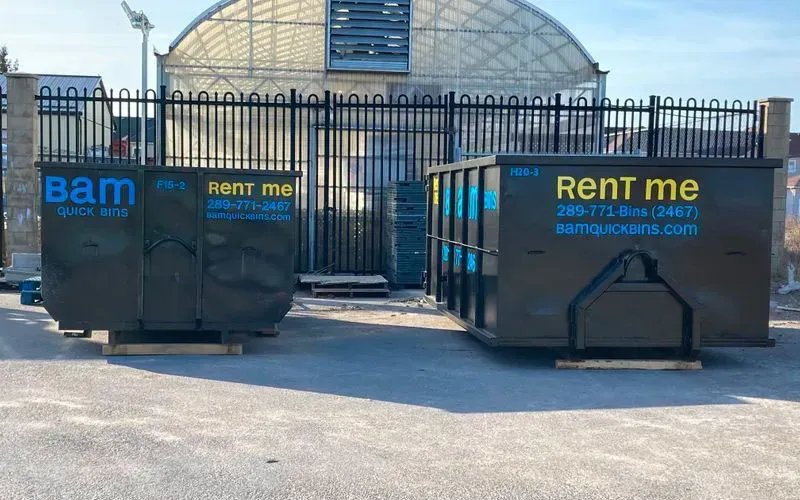
Contractors running pool removals can book through our construction bin rentals, and our bin size guide compares the sizes side by side.
After the pool
Even well-compacted fill can settle a little, especially after the first winter's freeze and thaw. Expect to top up low spots with topsoil in the spring, and watch that water drains away from the house rather than toward it. Hold off on heavy structures over a filled pool unless the fill was engineered and documented for that purpose.
Then enjoy the yard. Most people who remove a pool say the same thing afterward: they forgot how much space they had.
Where we help
We deliver bins for pool removals across southern and eastern Ontario, including Oakville, Ancaster, Kleinburg, King City, and Burlington. Tell us the type of pool, the size of the deck, and whether you are filling it in or removing it completely, and we will help you plan the bins.