Search for underground garbage bins and you will find a mix of terms: underground waste containers, deep collection bins, and Semi Underground Waste Containers. They describe related systems, but they are not all the same thing. For an Ontario property manager, condo board, or site planner, knowing the difference makes it easier to plan a waste area and to set up servicing that works.
This guide covers the main types of underground garbage system, how each one works, and what to think about before you commit to one. If you are new to the topic, our primer What is a Molok bin? is a good place to start.
What counts as an underground garbage bin?
An underground garbage bin is any waste container that stores most of its volume below grade instead of on a surface pad. Residents or staff drop waste in at ground level, and the stored waste sits below them until collection.
Most systems fall into two broad groups:
- Semi Underground Waste Containers, where roughly the top portion of the container stays above ground and the rest sits in an excavated hole.
- Fully underground waste containers, where the whole storage unit sits below grade and only a chute or small insertion column shows at the surface.
Both are different from surface dumpsters and wheeled carts, which hold all of their waste at ground level.
Semi Underground Waste Containers
Semi Underground Waste Containers are the most common type of underground garbage bin on Ontario multi-residential and commercial sites. Molok® is a well-known brand in this category, which is why many people use "Molok" as a general name for these units.
How they work:
- A shell is set into the ground. A large round or square container is installed in an excavated hole, with the upper section left above grade.
- Waste goes in through a lid at the top. The opening sits at a comfortable height for residents dropping bags.
- Depth does part of the work. Gravity settles the waste, and the below-grade section stays cooler than a surface bin, which helps with odour.
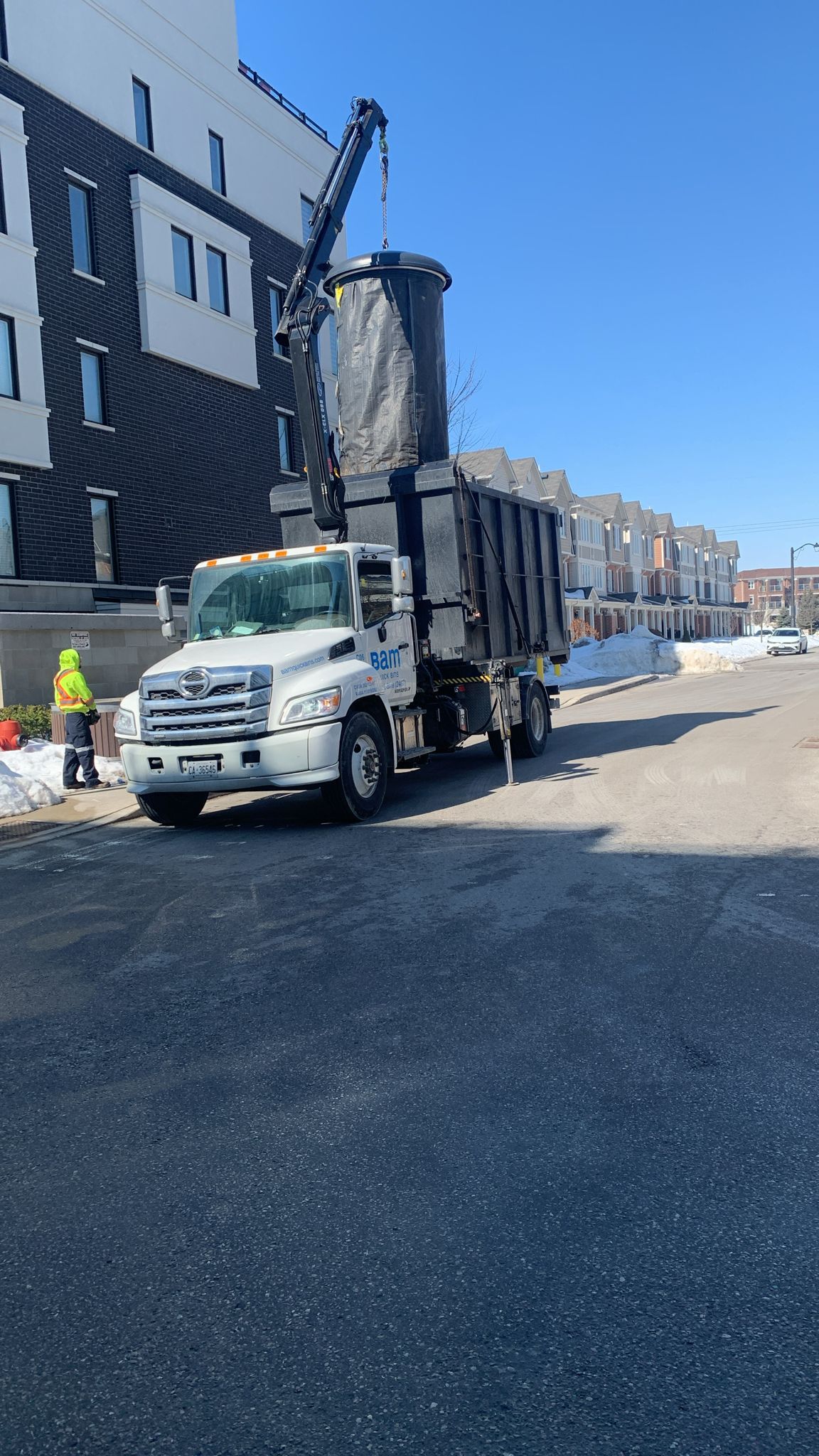
- A crane truck empties it. On collection day, a truck with a crane lifts the inner liner or bag out, empties it into the truck, and sets it back in place.
In French, especially in Quebec, you will often see these called a conteneur semi-enfoui. It is the same idea: a container that is partly buried.
Fully underground waste containers
Fully underground systems place the entire storage container in a concrete pit below the surface. At ground level, users see only an insertion column or a small hatch. Many of these systems use a lifting mechanism or a platform so that the container can be raised for emptying.
They tend to appear in dense urban projects where designers want almost nothing visible at street level. They usually involve more civil work at installation than semi-underground units, so they are more often part of a new build than a retrofit. The right choice depends on the site, the budget, and the design team, and it is worth discussing with your engineer or installer before planning around one.
Underground vs surface waste storage
| Factor | Underground garbage bins | Surface dumpsters and carts |
|---|---|---|
| Visible footprint | Small lid or column at grade | Full container on the pad |
| Odour | Below-grade storage stays cooler | Waste sits at ground level in the sun |
| Wildlife | Lids and depth make scavenging harder | Open lids and gaps attract animals |
| Capacity per pad area | Higher, because volume is below grade | Limited to what fits on the surface |
| Collection | Crane lift of the liner or container | Front-load or rear-load tipping |
| Flexibility | Fixed location once installed | Can be moved or resized more easily |
For a deeper look at one specific comparison, read Molok bins vs traditional dumpsters.
What to consider before choosing an underground garbage system
Site access for the truck. Underground containers are emptied by a crane truck, so the collection vehicle needs a clear approach, room to set up, and overhead clearance free of wires or tree canopy. This is the single most important planning question.
Waste streams. Many sites use separate units for garbage, recycling, and organics. Plan the number of units around your streams, not just your total volume.
Unit count and usage. Buildings with more units and heavier turnover need more capacity or more frequent collection. Move-in and move-out seasons put extra load on any system.
Placement for residents. Units work best on a clear walking path from entrances, with good lighting and room to reach the lid without stepping onto landscaping.
Bulky items. Underground lids only accept what fits through the opening. Furniture, renovation debris, and large cleanouts still need a separate solution, such as a roll-off bin rental.
Servicing plan. An underground garbage system is long-term infrastructure. Before or soon after installation, line up a service partner who has the right equipment and can work to a steady schedule.
How underground waste containers are serviced
Servicing Semi Underground Waste Containers follows a simple cycle: the crane truck arrives, lifts the liner out, empties it, checks that the liner and lid are in good shape, and resets it. Collection frequency depends on unit size, number of units, the waste stream, and the season. A good service partner sets that frequency with the property team after looking at how the site is actually used, then adjusts it as needs change.
Bam Quick Bins services Molok® and similar Semi Underground Waste Containers for property managers across our Ontario corridor. See how we handle it on our semi underground waste container servicing page, or open a city page such as Toronto, Ottawa, Mississauga, Hamilton, Kingston, or Peterborough.
Quick answers
Are underground garbage bins the same as Molok bins?
Molok® is one brand of Semi Underground Waste Container. In everyday use, people often say "Molok" for any semi-underground unit, but other makers and fully underground systems exist too.
Do underground garbage bins smell less?
Storing waste below grade keeps it cooler and farther from people, which usually helps. A regular collection schedule still matters most.
Can underground waste containers be added to an existing property?
Semi Underground Waste Containers are often added to existing sites, because they need an excavated hole rather than a full concrete vault. Whether it works on your site depends on underground services, soil, and truck access, so talk to an installer first.
Who empties them?
A service provider with a crane truck. Bam Quick Bins services installed Semi Underground Waste Containers for property teams across Ontario.
Talk to Bam about servicing your underground garbage system
If you manage a site with Semi Underground Waste Containers, or you are planning one and want to understand servicing before you build, Bam Quick Bins can help. Start with our semi underground waste container servicing overview and reach out to set or review a schedule.