
Carpet removal is one of the most satisfying jobs in home renovation. In a single afternoon, a dated, stained room turns into a blank slate, and sometimes you find a perfectly good hardwood floor that someone covered up in 1978. It is also a job most homeowners can do themselves with a few inexpensive tools.
This guide covers how to remove carpet the right way, from the first cut to the last staple, what to watch for underneath, how much the old flooring weighs, and how to get rid of it all without filling your garage with rolls of old broadloom for a month.
Tools you need
You do not need much, but having the right tools makes the difference between a three-hour job and a miserable weekend:
- A utility knife with plenty of spare blades. Carpet backing dulls blades fast, and a dull blade is how people slip and cut themselves.
- A flat pry bar and a hammer, for tack strips.
- Pliers or locking pliers, for gripping carpet corners and pulling staples.
- A floor scraper, for stubborn pad residue and staples.
- Knee pads. You will spend most of the job on your knees.
- Heavy work gloves. Tack strips are lined with small, sharp nails.
- A well-fitted dust mask. Old carpet holds years of dust and allergens.
- Duct tape and contractor bags, for rolling and bagging.
Optional but handy: end nippers for staples, a carpet knife with a hooked blade, and a shop vacuum for the final cleanup.
Before you start
Clear the room completely. Take doors off their hinges if they swing over carpet; it saves endless shuffling. Vacuum the carpet one last time, which sounds silly but cuts down the dust you will breathe while working. Open a window if the weather allows.
Baseboards can usually stay put. In most homes, carpet is tucked under the baseboard edge or stopped just short of it, and it pulls out without removing trim. If there is quarter-round or shoe moulding at the base, you may want to remove that and set it aside.
One important check before you go further: if your home was built before about 1990 and you suspect there is old vinyl tile or sheet flooring under the carpet, be careful. Some older vinyl tiles and the adhesive beneath them contain asbestos. Pulling up carpet over them is fine; scraping, sanding, or breaking the tiles underneath is not. Our guide to asbestos testing explains when and how to test before disturbing them.
Step by step: pulling up the carpet
Start in a corner. Grab the carpet with pliers and pull it up off the tack strip; it should release with a tearing sound. Once you have a corner free, work along the wall, pulling the edge up all the way around the room.
Now cut it into strips. Fold the carpet back, and from the back side cut it into strips about three feet wide. Cutting from the back is easier, because the knife slides along the backing instead of fighting the pile. Strips this size roll into manageable bundles that one person can carry.
Roll each strip tightly, backing side out, and tape it closed. Tight rolls take up a fraction of the space of loose ones, which matters when you are loading a bin.
The pad and the staples
Under the carpet is the underpad, usually foam. On a wooden subfloor it is held down with staples, sometimes hundreds of them. On concrete it is often glued.
Pull the pad up in sections, roll or fold it, and bag it. Then deal with the staples. This is the tedious part. Work across the floor in rows with pliers or a floor scraper, pulling every staple and dropping it in a bucket. If you plan to install new carpet, some installers will tell you that staples can simply be hammered flat, but if you are installing any hard flooring, every one needs to come out.
Glued pad on concrete comes up with a scraper and patience. A long-handled floor scraper saves your back.
Tack strips
Tack strips are the thin wooden strips around the edge of the room with rows of sharp nails pointing up. They grip the carpet edge. Most of the time you want them gone.
Slide your flat bar under the strip close to each nail and pry it up. Work along the strip rather than trying to lever the whole thing up from one end, which snaps it and leaves nails behind. On concrete, strips are usually held with masonry nails and can be stubborn; pry gently to avoid chipping the slab.
Wear gloves for this entire step and drop the strips straight into a sturdy box or bucket. Loose tack strip in a garbage bag is how people end up with punctured hands during loading.
Stairs, closets, and other tricky spots
Stairs take the most patience. Stair carpet is usually wrapped around each step and held with staples on every tread and riser, plus tack strips at the back of each tread. Start at the top, pull the carpet free step by step, and expect to spend more time on staples here than anywhere else. If there is a metal nosing or edge strip, unscrew it before you start pulling.
Closets are easy to forget until you are done with the room. Pull closet carpet at the same time so you are not cutting a seam at the closet door later.
Around heating registers, lift out the register cover first, then cut the carpet around the opening. At doorways, look for metal or wooden transition strips where carpet meets another floor; these usually pry up or unscrew, and new flooring will need its own transition anyway.
Mistakes to avoid
- Cutting from the pile side with a dull blade. It is slow, and it is how knives slip.
- Rolling strips loosely. Loose rolls fill a bin with air.
- Leaving tack strip nails behind when a strip snaps. Go back for them.
- Bagging tack strips in thin garbage bags. Use a box or a bucket.
- Scraping old vinyl tile underneath before you know what it is made of.
What you might find underneath
Carpet removal is a bit of a lottery. You might find:
- Hardwood, sometimes in good condition, sometimes needing a full refinish.
- A plywood or particleboard subfloor, ready for new flooring.
- Concrete, common in basements and newer slab homes.
- Old vinyl or linoleum, which may need its own removal, with the asbestos caution above.
- Stains, especially from pets. Urine soaks through carpet and pad into the subfloor, and the smell can linger. Sealing the stained subfloor with a stain-blocking primer before new flooring usually handles it.
If you find hardwood worth saving, protect it during the rest of the job. Work carefully with the pry bar around the edges and keep grit off the surface.
Before the new floor goes down
With the carpet, pad, and tack strips gone, take an hour to check the floor before anything new covers it again.
On concrete, especially in a basement, check for moisture. A simple test is to tape a square of clear plastic, about 60 centimetres on a side, tightly to the floor and leave it for a day or two. Droplets on the underside, or a darkened patch of concrete beneath it, mean moisture is coming up through the slab. Solve that before you lay a floor that could trap water.
On wood subfloors, walk the whole room and listen for squeaks. A few screws driven through the subfloor into the joists fix most of them, and it is far easier to do now than after the new floor is down. Look for soft spots and water stains too, especially near bathrooms and exterior doors.
Pet stains are the other thing carpet hides. Urine soaks through the pad into the subfloor or concrete, and the smell can come back through a brand new floor. Clean the stains with an enzyme cleaner, let them dry completely, and seal stained wood with a stain-blocking primer before the new flooring goes in.
How much old flooring weighs
Carpet is bulky but surprisingly light, and that matters when you are deciding how to get rid of it. Here are rough weights for common flooring, per square foot, as it comes out of the house:
| Flooring | Rough weight per square foot |
|---|---|
| Carpet | 0.3 to 0.7 lb |
| Foam underpad | 0.1 to 0.2 lb |
| Vinyl plank | About 1 lb |
| Laminate | 1.5 to 2 lb |
| Solid hardwood | 2.5 to 3 lb |
| Ceramic tile with mortar | 4 to 6 lb |
So a thousand square feet of carpet and pad comes to roughly 400 to 900 pounds. Wet carpet is a different story: after a flood it can weigh several times as much, which is why flood cleanups need their own planning. Our guide to flooded basement cleanup covers that.
Sizing the bin
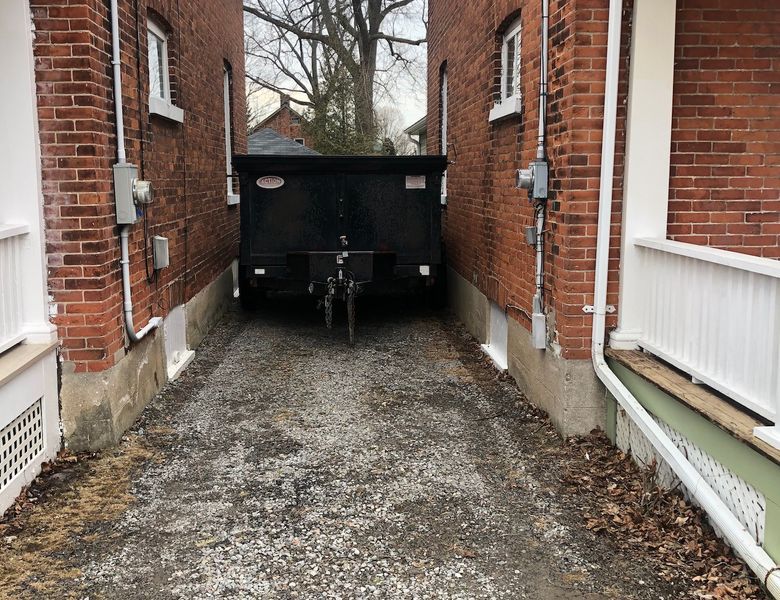
For carpet alone, volume decides. A whole house of carpet and pad, rolled tightly, usually fits comfortably in a 10-yard bin, which holds about three to four pickup-truck loads.
Mixed flooring tear-outs change the math. Hardwood and especially tile are heavy, and a tile floor of a few hundred square feet can approach or pass the 1 metric tonne of disposal included with a standard rental. If you are removing tile or hardwood along with carpet, tell us when you book, and read our guide to dumpster weight limits. The cubic yard calculator can also help you estimate volume and weight before you call.
Our residential bin rentals come in 10, 15, and 20-yard sizes, with boards under every bin to protect your driveway, and the bin size guide compares them by project.
Can old carpet be recycled?
Sadly, not often. Carpet recycling options in Ontario are limited, especially for residential broadloom, because carpets are made of mixed fibres and backings that are hard to separate. Some commercial carpet tile programs exist through manufacturers, but most household carpet still goes to landfill.
Clean, recent carpet in good condition can sometimes be rehomed through a buy-and-sell listing for use in a garage, workshop, or cottage. Old, stained, or pet-damaged carpet should go straight into a bin. Underpad sometimes has more recycling options than carpet, so it is worth checking locally.
Where we help
We deliver bins for flooring projects across southern and eastern Ontario, including Oshawa, Brampton, Kingston, and Barrie. If your carpet removal is part of a bigger renovation, our guides to kitchen demolition and bathroom demolition cover the rest of the tear-out.