
An office clear-out usually arrives with a deadline attached. The lease is ending, the company is downsizing to a smaller floor, or half the staff now work from home and nobody needs forty cubicles anymore. Suddenly someone in facilities owns a very specific problem: office furniture disposal, on a schedule, without blowing the budget or annoying the landlord.
The good news is that office cleanouts follow a pattern. Do the steps in the right order and the job gets smaller at every stage. Do them out of order, usually by booking a bin first and figuring out the rest later, and you end up paying to throw away things someone would have taken for free.
Start with an inventory, not a dumpster
Walk the space with a notepad or a spreadsheet before anything else. Count desks, chairs, filing cabinets, workstation panels, tables, shelving, and the odd items every office collects, like whiteboards, coat racks, and the broken chair in the storage room that everyone was saving for parts.
Note condition as you go: good, worn, or broken. Note brand where you can see it, because quality task chairs and systems furniture from known manufacturers have a real resale market. And note anything that is not furniture at all, because electronics and confidential paper need their own handling, which we will get to.
This list does two jobs. It tells resellers and donation partners what you have, and it tells you how much will actually end up in a bin. That second number is almost always smaller than people expect once the reusable pieces are gone.
Sell, donate, or reuse first
Used office furniture is a real business. Dealers and liquidators buy, collect, and resell desks, chairs, and workstations, especially when the pieces are matching sets in decent shape. They may not pay much, and some will simply take the furniture away at no cost, but either outcome beats paying to dispose of it.
A few honest realities about what moves:
- Good task chairs sell well. Worn ones with torn upholstery or broken mechanisms do not.
- Workstation systems are worth more as complete, matching sets than as a pile of panels.
- Solid wood and steel furniture holds value better than laminate and particleboard.
- Filing cabinets, especially lateral steel ones, are easy to rehome or scrap.
Charities, schools, and non-profits sometimes take office furniture too, though most have limited space and want to see photos first. Staff are another overlooked outlet. Offering chairs and small tables to employees for home offices clears pieces quickly and earns some goodwill on the way out.
Give this stage real time. Resellers book up, and donation groups need lead time to arrange pickup. Starting four to six weeks out makes a big difference.
Files and electronics need their own plan
Two categories should never go into a disposal bin without a plan: paper records and electronics.
Under PIPEDA, Canada's federal privacy law for private-sector organizations, a business is responsible for protecting personal information, and that responsibility lasts right through disposal. Old client files, HR records, and invoices should be shredded by a secure shredding service that provides a certificate of destruction, not tipped into an open bin where anyone can read them.
Computers, monitors, phones, printers, and servers belong in Ontario's electronics recycling stream, which is free to use. Before anything leaves the building, wipe or destroy the data. That includes the copier: many office copiers and printers store copies of scanned documents on an internal drive. Our guide to e-waste disposal covers data wiping and collection in detail, and bulk business electronics can go through certified recyclers who document what happened to each device.
Breaking down workstations
Once the reusable furniture and the sensitive material are gone, what remains is the real disposal job. Breaking furniture down before it goes into a bin saves space and makes loading safer.
Most workstations come apart with basic tools: a drill with a selection of bits, a socket set, and a pry bar for anything glued. Panels unbolt from their frames. Work surfaces lift off brackets. Pedestals and drawers come out in one piece. Keep a bucket for hardware; it disappears into the carpet otherwise.
A few cautions from the loading side. Glass tabletops and whiteboard glass should be wrapped or taped before they go in, so they cannot shatter onto the person loading the next piece. Particleboard desks are heavier than they look and crumble at the corners, so carry them flat with two people. Steel filing cabinets should be emptied completely; a full four-drawer cabinet is a back injury waiting to happen.
Steel is also worth separating. Filing cabinets, shelving, and metal desk frames can go to a scrap yard rather than a bin, and our guide to scrap metal recycling explains what is worth pulling aside.
Powered workstations and other hidden wiring
Modern cubicles often have power and data running through the panels, fed from the floor or the ceiling. Those base feeds are usually hardwired into the building's electrical system, which means unbolting a panel without disconnecting it first is a genuine shock risk. Before anyone starts taking workstations apart, have an electrician disconnect and cap the feeds. It is a short job for them and a dangerous one for a well-meaning office manager with a cordless drill.
The same goes for anything mounted to walls or ceilings: televisions in boardrooms, projector mounts, and under-desk power bars that were screwed in place years ago. Check what your lease says about these fixtures too. Some landlords want mounts removed and holes patched, while others prefer that cabling stays for the next tenant. Asking first saves you from removing something you were supposed to leave, or leaving something you were supposed to remove.
The chair problem
Chairs are the hardest item in any office cleanout. They are bulky, they do not stack once they are worn out, and they are made of half a dozen materials bolted together: steel bases, gas cylinders, nylon casters, plastic shells, foam, and fabric. Very little of that separates easily, so a broken chair is almost always landfill.
That makes chairs the item most worth rehoming. A decent task chair is something a former employee, a student, or a small business will gladly take. Some manufacturers of higher-end office seating also run take-back or refurbishment programs for their own products, so if your chairs carry a well-known brand, it is worth a quick search before they go anywhere. The broken ones can go in the bin with everything else; they are perfectly acceptable, they just take up more room than you would expect.
Building logistics: elevators, docks, and paperwork
Office buildings run on rules, and a cleanout that ignores them stalls on day one. Talk to the property manager early about:
- Freight elevator bookings. Many buildings require reservations and padding, and some restrict moves to evenings or weekends.
- Loading dock hours and rules, including how long a truck or bin can sit there.
- Certificates of insurance. Building managers often require vendors working on site to provide proof of liability insurance before they can start.
- Where a bin can go. Some buildings have room at the dock; others need the bin in a back lot, which means a longer carry.
- Your lease's restoration clause. Many commercial leases require the space to be returned in a specific condition, which can mean removing cabling, signage, or even fixtures you installed.
If the only workable spot for a bin is on a city street, that usually needs a municipal permit, so plan for it early or find private space instead. Our guide to where to put a bin covers placement and permits in more detail.
Sizing the bin
Office furniture is bulky but not especially heavy, apart from steel and particleboard. As a rough planning number, one broken-down workstation (the desk, its panels, a pedestal, and a chair) takes up about a cubic yard in a bin, give or take. On that basis, a 20-yard bin handles somewhere around fifteen to twenty workstations' worth of furniture once the reusable pieces are gone.
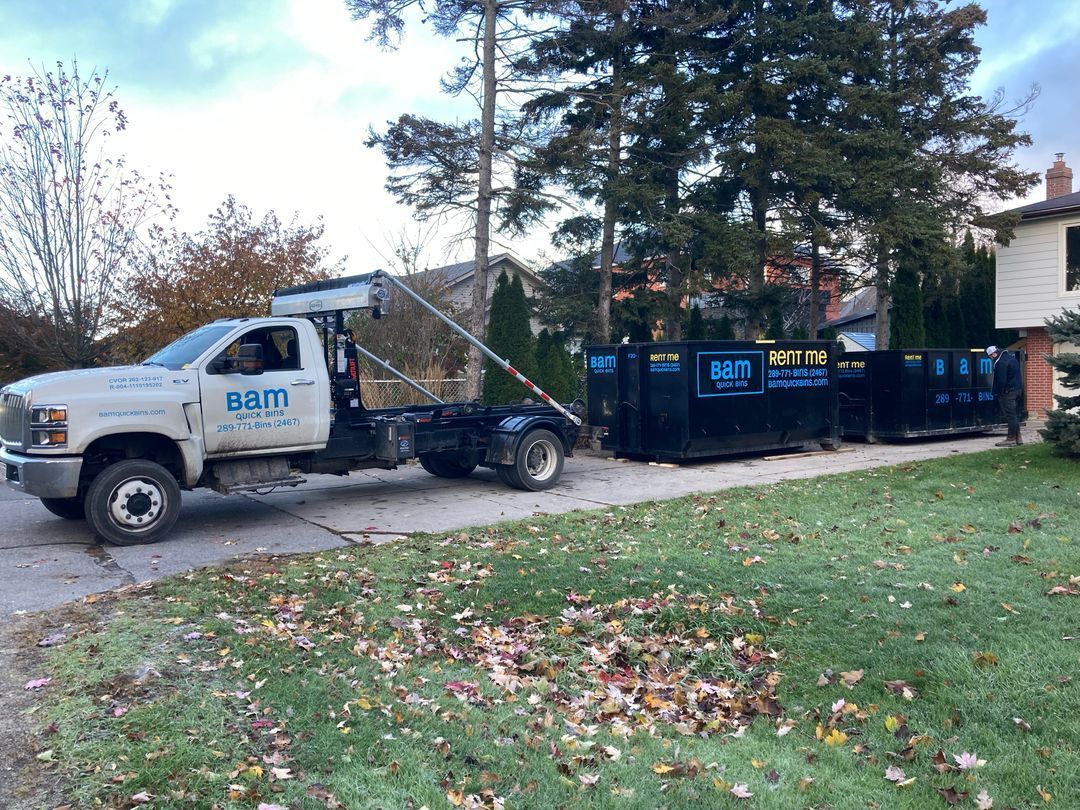
That is an estimate, not a promise, and the honest way to use it is as a starting point. Bigger floors are usually better served by one 20-yard bin with scheduled swaps than by several bins at once, since dock space is limited and a swap keeps the work moving. Our roll-off dumpster rentals come in 10, 15, and 20-yard sizes, and the bin size guide compares them in more detail.
If you would rather not load anything yourself, our junk removal service works on the same bin-based model with a flat rate, which suits smaller suites where a full crew would be overkill.
A timeline that actually works
Six weeks out: walk the space, build the inventory, and contact resellers, liquidators, and donation partners. Ask the property manager for building rules.
Four weeks out: confirm pickups for resale and donation. Book secure shredding and electronics recycling. Offer leftover pieces to staff.
Two weeks out: book the bin and any swaps, reserve the freight elevator, and send insurance certificates to the building.
The final week: break down and load what is left, working from the back of the space toward the exit. Keep a clear path for the last trips.
After the move: walk the empty space with the landlord against your lease's restoration requirements, so nothing surprises you when the deposit comes back.
Where we clear offices
We place bins for office cleanouts and moves across southern and eastern Ontario, including the tech parks of Kanata, business districts in Concord and Markham, and office corridors in Mississauga, Toronto, and Waterloo. Call 1-888-771-2467 with your inventory and your move-out date, and we will help you plan the bins around the building's rules rather than against them.