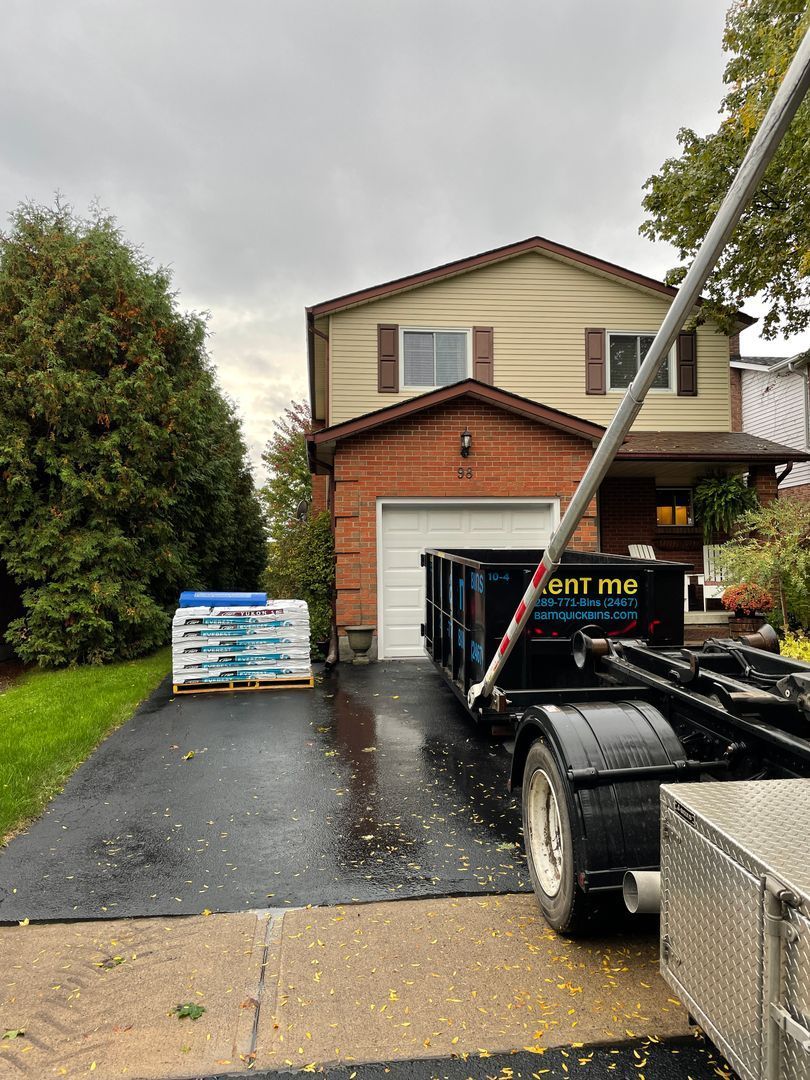
Short answer: bin rental cost in Ontario comes down to five things: the size of the bin, how many days you keep it, how much weight the price includes, what you are throwing out, and where the bin is going. If you are wondering how much it costs to get a dumpster at your house for a cleanout or a renovation, the answer is one flat price for the bin, not an hourly bill.
With us, every residential price is a 5-day rental with 1 metric tonne of disposal included, and boards go under the bin to protect your driveway. Our current prices for each area, in 10, 15 and 20-yard sizes, are on the pricing page. The rest of this guide explains what moves that number up or down, and how to avoid paying for a bin twice.
What you are paying for when a bin lands in your driveway
A bin rental price bundles several costs into one number: the truck trip to drop the bin off, the days it sits on your property, the trip back to collect it, and the disposal fee at the facility where the load ends up. Disposal is the part people forget. Every load goes over a scale at a transfer station or landfill, the facility charges by weight, and that charge is built into what you pay.
That is why a flat price always comes with terms attached. Ours are short: 5 days, 1 metric tonne, boards under the bin. If your job fits inside those, the price on the page is the price. If it needs more days or will carry more weight, tell us when you book and your local team will quote it before the bin arrives, so the bill matches what you agreed to.
The five things that set bin rental cost
1. Bin size
We rent 10, 15 and 20-yard roll-off bins. All three are 12 feet long, so the difference is height and width, not how much driveway they take. A bigger bin costs more, but not in proportion. On our price list the 20-yard is nowhere near double the 10-yard, because the truck trip is the same whichever size you pick. The size pages for the 10-yard, 15-yard and 20-yard bins show what each one suits. Our Cambridge division runs 9 and 14-yard bins plus a 20-yard.
2. Rental days
The standard rental is 5 days, which covers a weekend cleanout with slack on both ends. Extensions are available on request. Keeping the bin past 5 days adds to the price, so if you already know the job will run two weeks, say so when you book instead of on day six.
3. Weight allowance
Weight is where most surprise charges come from, at any company. Our price includes 1 metric tonne of disposal. A garage full of household junk and furniture rarely gets near that. A bathroom tear-out with tile and mortar, a plaster-wall gut or a roof tear-off can pass it quickly, and going over the included tonne adds cost. Our weight limits guide and the material weight chart help you estimate before you book.
4. What goes in it
Household junk, furniture, renovation debris and yard waste all ride in a regular bin. Heavy fill is a different job. Soil, concrete, brick and asphalt are so dense that we plan them as dirt and concrete bins, sized so the truck can still lift the load. Some things cannot go in at all: hazardous waste, cleaning chemicals, propane tanks, batteries and tires. A load with those in it can be turned away at the facility, and that costs somebody money.
5. Where the bin is going
Disposal rates and driving distances vary across the province, so a fair company prices by area instead of quoting one number for all of Ontario. Each of our local divisions sets its own price list for the area it serves. That is why the same 15-yard bin costs a different amount in Belleville than it does in Peterborough.
Why the price changes from town to town
We run seven staffed divisions, each with its own phone line: Cobourg, Whitby, Peterborough, Belleville, Kingston, Innisfil and Cambridge. Each one publishes its bin prices, and the pricing page puts them side by side. If your town is served by one of those divisions, like Barrie from Innisfil or Napanee from Kingston, your price is that division's price.
Toronto and the GTA, Hamilton, Niagara and Ottawa are served too, and prices there are quoted by phone at 1-888-771-2467. That is not a trick to get you on the line. Disposal costs and travel in those markets change enough from one address to the next that a quoted number is more honest than a posted one.
How the price plays out on common jobs
Prices differ by area, but the way they behave is the same everywhere. Four jobs we see every week show where the money goes.
A single-garage cleanout. Old furniture, boxes, a bike with two flat tires, sports gear. That is a 10-yard bin, it is light for its size, and it usually finishes inside the included tonne and the 5 days. The posted price is usually the whole bill.
A kitchen renovation. Cabinets, countertops, drywall and flooring. A 15-yard bin handles the volume. The risk is weight: ceramic tile, a mortar bed or old plaster walls can push the load toward the tonne, so tell us what is coming out.
A roof tear-off. Small in volume, heavy in weight. A 10 or 15-yard bin, sized for the shingles, not the size of the house. This is the job most likely to need extra weight quoted up front.
An estate or whole-house cleanout. Volume is the issue, not weight, so a 20-yard bin is common, and these jobs often need a few extra days. Ask for the extension when you book and the rental matches the pace the family needs.
Costs that can show up beyond the base price
Most rentals never see an extra line on the bill. When one does appear, it is almost always one of these:
- Extra days, when the bin stays past the 5-day rental.
- Extra weight, when the load goes over the included tonne. Shingles, tile, plaster, wet drywall and soil are the usual causes.
- A street permit. A bin on your own driveway needs no permit. A bin on a municipal road does (Toronto and Mississauga, for example, both require one), the municipality sets that fee, and we can help you arrange it.
- Items that should not be in the bin. Tires, propane tanks, paint, batteries and chemicals each have their own disposal route. Pull them out before pickup.
- Overfilling. A load piled above the rim cannot be tarped and hauled safely, so keep it level with the top edge.
Contractors who book regularly can ask their division about contractor rates. Those run on a 7-day billing period with disposal charged separately. That suits crews who fill bins every week, and it rarely suits a one-off homeowner job.
How to compare quotes without getting burned
A rock-bottom advertised price usually has something stripped out of it. When you line up quotes, ask every company the same questions:
- How many days does the price include?
- How much weight is included, and how is extra weight charged?
- Are delivery and pickup in the number, or added at checkout?
- Is the quote for my town, or a general starting price?
- What happens if my load has a mattress, an appliance or shingles in it?
- Does anything go under the bin to protect my driveway?
If a company cannot answer the weight question clearly, assume the cheap number will not be the final number. Compare the full price for your actual address and the weight your job will really produce. Our guide to junk removal cost covers the same questions for crew-based hauling, if you are weighing the two.
How to keep your bin rental cost down
The cheapest bin is the one you only rent once. A few habits keep it that way.
Size for the whole job, not the first weekend. Undersizing to save a little is the most expensive mistake we see, because a second delivery costs far more than the step up to the next size would have. If you are torn between two sizes for a general cleanout, the bigger one is usually the cheaper outcome. The bin size guide settles most debates.
Go smaller for heavy material. That is the exception to the rule above. Shingles, tile and plaster reach the weight allowance long before the bin looks full, so a bigger bin only gives you more room to go over. Our roofing dumpster guide walks through the math for a tear-off.
Load flat and tight. Break down furniture, lay panels flat and fill the corners. A well-packed 10-yard holds a surprising amount of what people expect to need a 15-yard for.
Keep heavy fill out of the general bin. A few wheelbarrows of soil or broken concrete can push an otherwise light load over the tonne. Plan heavy fill on its own.
Time the delivery. If you are clearing on a weekend, have the bin arrive Friday so the 5 days cover the work and leave room to finish.
Pull the banned items first. Set tires, paint and propane aside before loading starts and take them to the right drop-off. Our list of what can and cannot go in a rental bin has the full rundown.
When a bin is not the cheapest option
Sometimes a bin is the wrong tool for the money. For a small pile under a tonne, a Bam Bag often costs less than a bin and does not need a truck backing onto your driveway. When the pile is furniture and household junk rather than renovation debris, our junk removal service drops a bin for a flat rate and you load it at your own pace.
For one or two items, your municipality's large-item collection or a trip to the local depot may be cheaper still, if it is offered where you live and the timing works. We would rather tell you that than rent you a bin you did not need.
Getting your exact price
Open the pricing page, find your area and pick the size. In a division area, the number there is your 5-day, 1-tonne price. In Toronto, Hamilton, Niagara, Ottawa or anywhere else we serve, call 1-888-771-2467. Either way, tell us what you are throwing out. Half a minute of description at booking is what keeps the final bill the same as the first quote.
Not sure which size you need? Give us the project, a rough idea of the rooms or the roof, and the heaviest material in the pile. We would rather spend two minutes on the phone sizing it properly than sell you a bin that is too small or too heavy.